
Solid wood, veneer or laminate in a Maltese home?
Three constructions, one climate. What is actually sold in Malta, why laminate and veneered cores dominate the supply, and what changes for imported hardwood from 30 December 2026.
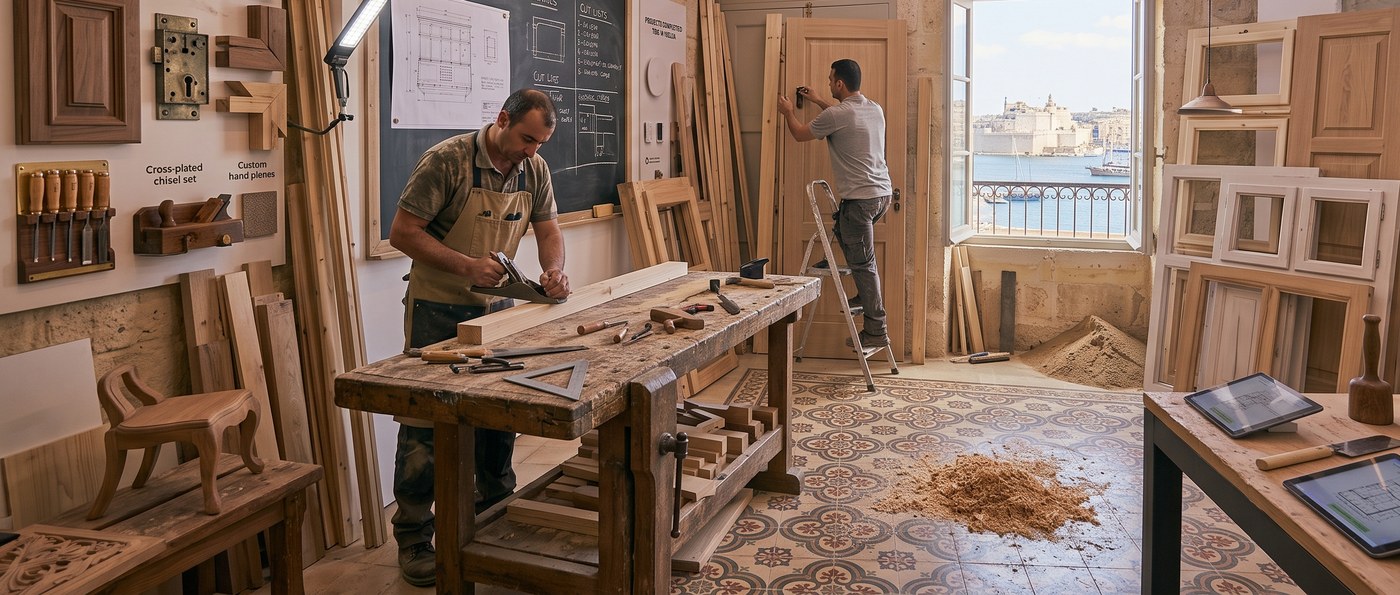
Buyers arriving from the UK or elsewhere in northern Europe often carry a hierarchy with them: solid wood at the top, veneer as a compromise, laminate as the cheap option. That ranking is a habit of a different climate and a different supply chain. In Malta the three constructions are better understood as three answers to one question — how much do you want this thing to move?
The three constructions
Solid wood is timber all the way through, usually glued up from narrower staves rather than cut from one board. It can be sanded back and refinished repeatedly. It also expands and contracts across the grain as it takes up and gives off moisture from the air, and the wider the panel, the more absolute movement you get.
Veneer is a thin sheet of genuine timber bonded to an engineered core — MDF, chipboard or a lightweight honeycomb. The face is real wood with real grain, so it looks like timber and takes a timber finish. The core is dimensionally stable and does not move the way a solid panel does. The trade-off is that the veneer layer is thin: you get one light sanding out of it, if that, and an edge knock that goes through to the core cannot be repaired invisibly.
Laminate is a decorative surface — a printed or resin-impregnated sheet — pressed onto the same kind of engineered core. There is no timber layer at the face. It is the hardest-wearing of the three against scuffs and cleaning, the most stable, and the only one where a deep scratch is permanent. Because the pattern is printed, it repeats.
What is actually sold here
Prices for the same nominal item separate quickly. On MaltaDIY's internal hinge door range, a solid-wood leaf is listed at €239, while painted MDF and laminate leaves start from €169. That is the honest gap at the leaf level: solid wood costs more, but not so much more that price alone explains why it is the minority product.
Dimech Enterprises sells hinged and sliding doors in laminate, wood and glass as a made-to-measure range. Made-to-measure laminate is the mainstream fitted option in Malta — it is what a joiner will assume you mean unless you say otherwise, and it is what most flat fit-outs here are built from.
| Face | Core | Repairable | Typical Maltese use | |
|---|---|---|---|---|
| Solid wood | Timber | Timber | Sand and refinish | Front doors, feature joinery, traditional apertures |
| Veneer | Real timber sheet | MDF, chipboard, honeycomb | Once, lightly | Wardrobes, internal doors where grain matters |
| Laminate | Printed or decorative sheet | MDF, chipboard, honeycomb | No | Fitted wardrobes, kitchens, internal doors |
Why the engineered cores dominate
Three reasons, and only the first is about money.
Everything arrives by sea. Solid hardwood is heavy, it is imported in board form, and it has to be conditioned before it is worked. Sheet goods travel flat and predictably. For anything going to Gozo there is a ferry crossing on top of that, on every delivery and on every return trip if something is wrong.
Most property here is sold in shell form, which means the joinery is specified late, all at once, and by a buyer who has already spent heavily on the structure. Made-to-measure laminate is the product that answers "I need every wardrobe, door and kitchen carcass in this flat, to these odd apertures, by a date." It is a volume trade, and the supply chain has arranged itself around that.
And Maltese rooms are not heated the way northern rooms are. A flat that sits through a damp, unheated winter and then a dry summer puts a solid panel through a large annual moisture cycle, with the joinery closest to an external wall or an aperture seeing the worst of it. An engineered core simply does not respond to that cycle the same way. This is the practical argument for laminate and veneer in Malta, and it is worth being clear that it is an argument about construction behaviour rather than a measured local finding — nobody publishes indoor humidity figures for unheated Maltese winter rooms, and this article does not yet carry a Maltese joiner or timber merchant on the record about it.
What follows from all this is not "never use solid wood". It is: use it where movement is expected and can be accommodated — a front door in a frame with room to move, a worktop, a piece of traditional joinery in a townhouse — and use engineered cores where a millimetre of movement ruins the job, which is every fitted wardrobe with a flush door and every run of kitchen units.
Salt air, and what we do not know
Coastal exposure is the other thing buyers ask about, and here the honest answer is that the sources do not establish anything. Nobody in the set publishes findings on how sea air affects finishes, adhesives or fixings on solid, veneered or laminate joinery in Malta. Treat any confident claim you are given on that subject — in either direction — as an opinion rather than a documented fact, and ask what it is based on.
The paperwork behind imported hardwood
If you are specifying imported hardwood for delivery in 2027 or later, the compliance regime is changing. The EU Deforestation Regulation applies from 30 December 2026, with micro and small enterprises following from 30 June 2027, under Regulation (EU) 2025/2650. The obligation falls on the operator placing the product on the EU market, not on the homeowner buying a door.
The regime it replaces is the EU Timber Regulation, which requires operators to exercise due diligence on timber legality. Timber placed on the market before 29 June 2023 has a grace period running to the end of 2028, so older stock does not simply fall out of the system on the EUDR start date.
For a homeowner the practical effect is second-order: more origin documentation moving through the chain, and the possibility that specialist hardwoods become slower or harder to source at short notice. It is a reason to decide on any solid hardwood element early rather than late in a fit-out.
Two Maltese constraints that are not about the material
Apartment works touch common parts more often than owners expect. Anything fixed to a party structure, a shared shaft or a facade sits under the condominium rules in Cap. 398, and the material you have chosen makes no difference to whether you need the other owners' agreement.
And there is no trade licence for carpenters in Malta. Unlike the UK, where buyers reach for scheme membership as a proxy, there is no register here and no official body that will confirm what a contractor has told you a door is made of. If the specification matters — solid versus veneered, core type, edge banding — get it written on the quotation, because the written quotation is the only record that exists.
Common questions
- Is solid wood better than laminate for a Maltese apartment?
- Not automatically. Solid timber moves with humidity across its full width, which matters in rooms that swing from damp winter air to dry summer air, while laminate and veneered engineered cores are built to move less. On MaltaDIY a solid-wood internal leaf is listed at €239 against painted MDF and laminate from €169, so solid wood is also the dearer choice. The honest answer is that the two are different products for different rooms, not better and worse.
- Is a veneered door real wood?
- The face is. A veneer is a thin sheet of genuine timber bonded to an engineered core such as MDF or chipboard, so the surface grain is real and the structure underneath is not. That is why a veneered door looks like timber and behaves like a board. Laminate, by contrast, is a printed or decorative surface with no timber layer, which is why it repeats and why a deep scratch does not sand out.
- Why does every Maltese joiner quote me laminate?
- Because it is the mainstream made-to-measure product here. Dimech Enterprises, for example, sells hinged and sliding doors in laminate, wood and glass as its made-to-measure range, and laminate is the volume option. It is dimensionally stable, it is the cheapest of the three at the door-leaf level, and it copes with the humidity swing in unheated rooms better than a wide solid panel does.
- Do I need EUDR paperwork to buy a hardwood door in 2027?
- As a private homeowner, no. The obligation sits on the operator placing the timber product on the EU market, not on you. Under Regulation (EU) 2025/2650 the EU Deforestation Regulation applies from 30 December 2026, with micro and small enterprises following from 30 June 2027. What you may notice is that suppliers ask for and pass on more origin documentation, and that some specialist hardwoods get harder to source at short notice.
What we could not establish
- No Maltese joiner or timber merchant is quoted here on indoor humidity. This article was drafted without a local source on the subject and one should be added before it is treated as authoritative.
- Nobody publishes measured indoor relative humidity figures for unheated Maltese winter rooms, so the moisture-movement discussion below is reasoning about how the three constructions work, not Malta-specific measurement.
- Neither MaltaDIY nor Dimech Enterprises publishes a moisture-content specification for the timber in their doors, so there is no way to compare kiln-drying between suppliers on published information.
- Dimech Enterprises does not publish prices for its made-to-measure doors, so the €239 and €169 figures cited are MaltaDIY's off-the-shelf leaves only and are not comparable to a fitted, made-to-measure cost.
- The sources do not establish how coastal salt air affects finishes, fixings or adhesives on any of the three constructions in Malta.
- There is no register of carpenters in Malta and no trade licence, so there is no official body that verifies what a contractor tells you a door is made of.
Sources
- Internal Hinge Doors - MaltaDIY.com — MaltaDIY · read 2026-09-21
- Doors - Laminate Wood, Glass. Hinged & Sliding — Dimech Enterprises · read 2026-09-21
- Delay until December 2026 … implementation of the EUDR Regulation — European Commission Access2Markets · read 2026-09-21
- EUTR reporting timelines and EUDR takeover — Coolset · read 2026-09-21
Want this costed properly?
The calculator gives you a figure in a minute. A site visit gives you a fixed price.
Book a free survey